Project Overview
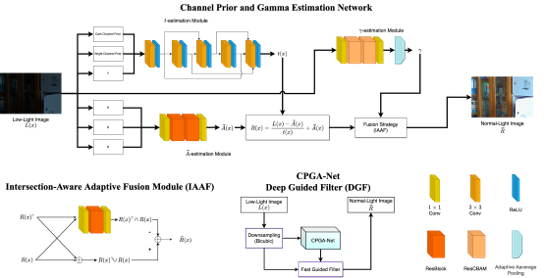
This research project focuses on developing Lightweight Low-Light Image Enhancement (LLIE) algorithms capable of real-time processing on edge devices. The core innovation lies in the CPGA-Net (Channel Prior and Gamma Estimation Network) and its advanced variant CPGA-Net+, which utilize channel priors and adaptive gamma correction to robustly enhance visibility in varying illumination conditions.
Core Techniques
CPGA-Net: Channel Prior & Gamma Correction
Introduced in our IJPRAI publication, CPGA-Net combines dark/bright channel priors with deep learning-based gamma correction. Inspired by the Retinex theory and Atmospheric Scattering Model, this architecture features:
- Ultra-Lightweight Design: 0.025 million parameters with an inference time of 0.030s.
- Feature Distillation: Exploring knowledge transfer from complex teachers to compact student models.
- Explainable Factors: Utilizing explicit gamma parameters for interpretable enhancement.
CPGA-Net+: Reshaping Theoretical Illumination
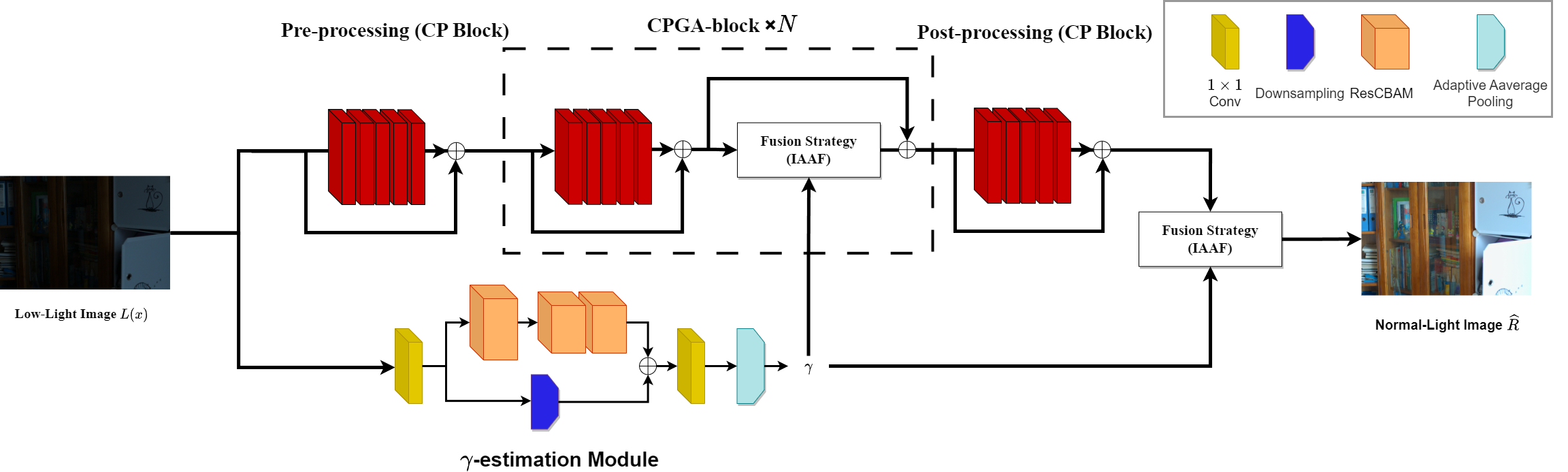
Detailed in our ArXiv preprint, CPGA-Net+ extends the framework with theoretically-based attentions for local and global illumination processing. This version achieves a significant balance between performance and computational cost, effectively addressing the "theoretical illumination" constraints of previous models.
Atmospheric Scattering for Driving Scenes
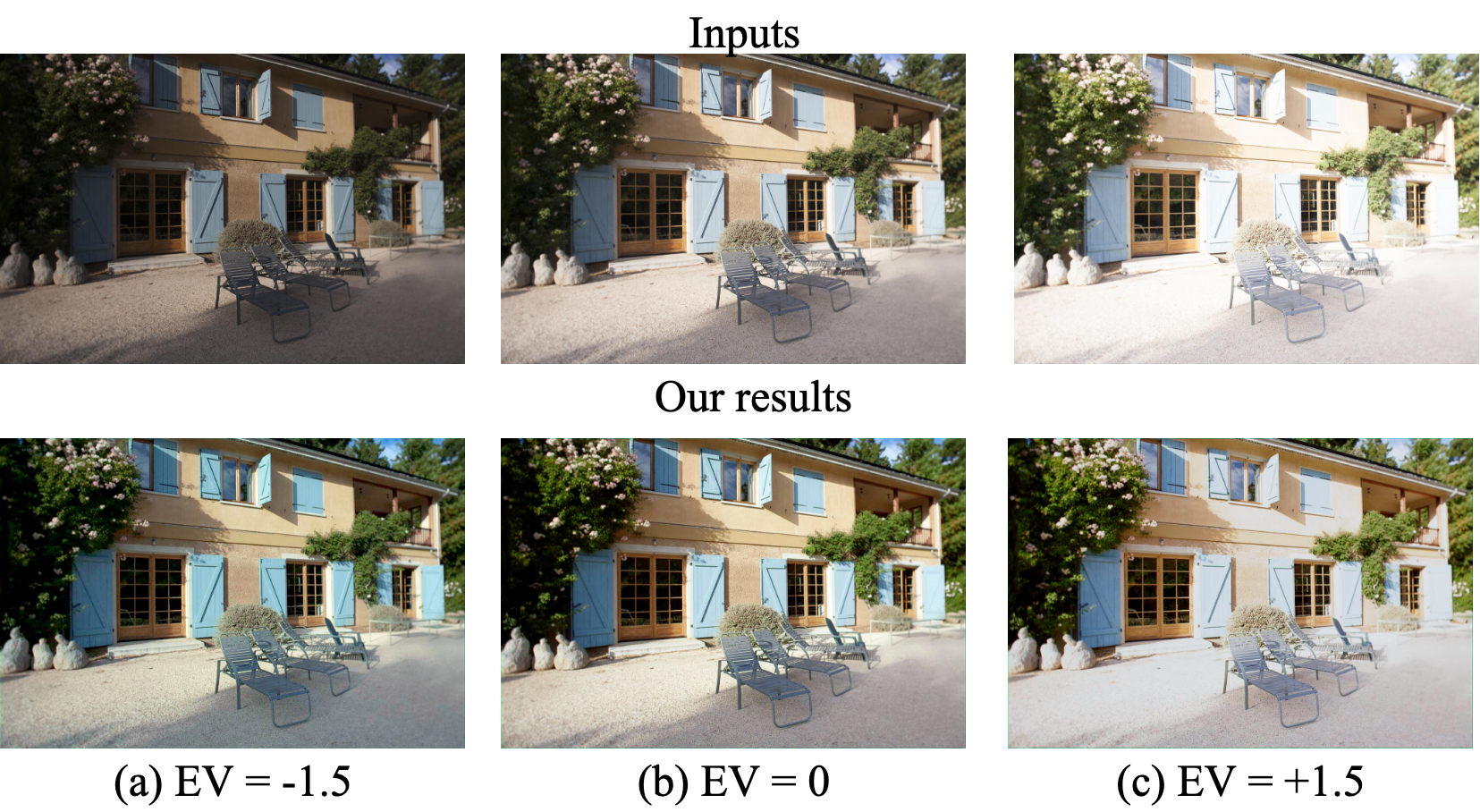
Our work presented at IEEE ICCE-TW 2024 specifically targets Exposure Correction in dynamic driving scenes. By grounding the enhancement in the atmospheric scattering model, the method improves object detection accuracy in challenging lighting, from tunnel exits to night driving.
Side Project: Edge AI Deployment
The lightweight nature of these models allows for deployment on resource-constrained hardware:
- iOS Implementation (CoreML)
- Jetson Nano (TensorRT)
- Neural Compute Stick 2 (OpenVINO)
Related Publications
arXiv preprint arXiv:2409.05274, 2024
arXiv Link
International Journal of Pattern Recognition and Artificial Intelligence (IJPRAI), 2025
DOI: 10.1142/S0218001425540138
IEEE ICCE-TW 2024
DOI: 10.1109/ICCE-TW55602.2024.10674535